
Saving $2 Million Through High-Resolution Site Characterisation
How Advanced MIP Technology Identified Hidden Contamination and Accelerated Site Remediation
The Challenge
A former industrial site contaminated with chlorinated solvents was undergoing environmental assessment prior to redevelopment. Historical investigations had been conducted over many years using conventional drilling, monitoring wells, and soil sampling programs.
Despite significant expenditure on investigations, consultants were unable to accurately identify the true source zone of contamination.
This uncertainty created major risks:
Potential remediation failure
Extended project delays
Increased environmental liability
Significant redevelopment costs
Ongoing regulatory concerns
Traditional investigation methods suggested contamination existed at depths between 5 and 6 metres. However, the data lacked the resolution required to confidently design an effective remediation strategy.
The Solution
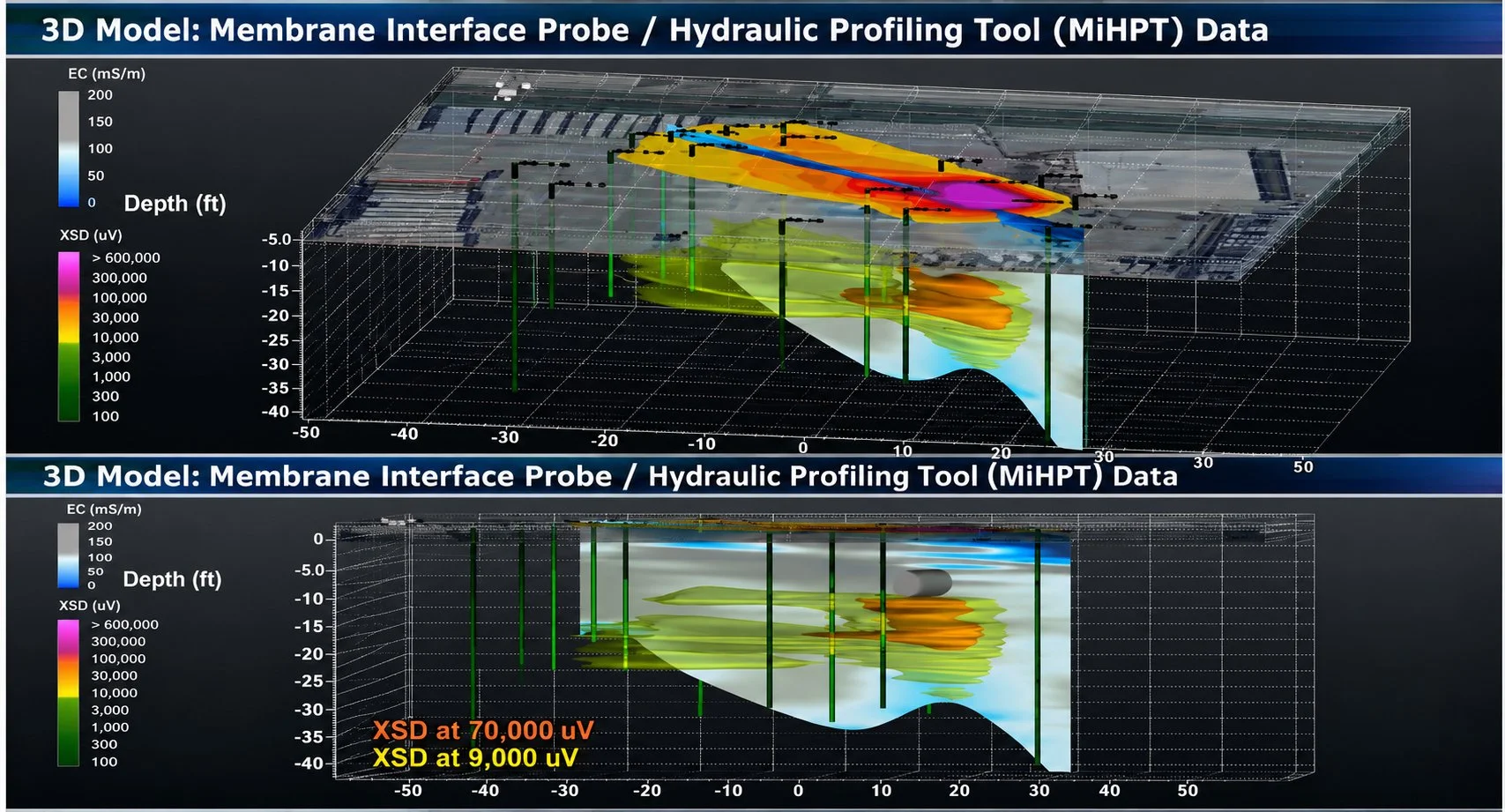
Legion Drilling deployed Membrane Interface Probe (MIP) technology, a high-resolution site characterisation (HRSC) tool capable of providing real-time contamination data throughout the subsurface.
Unlike conventional drilling methods that rely on isolated samples, MIP delivers continuous vertical profiling, allowing environmental consultants to:
Locate contamination source zones precisely
Identify preferential migration pathways
Reduce uncertainty in remediation planning
Optimise monitoring well placement
Create accurate 3D site models
By collecting thousands of data points in real time, the investigation generated a detailed understanding of contaminant distribution that would not have been achievable through conventional sampling alone.
What Was Discovered
The results completely changed the understanding of the site.
The investigation revealed that:
The primary contamination source zone was located between 0 and 1.5 metres below ground level
Historical investigations had incorrectly focused on deeper contamination zones
The contamination was both laterally and vertically inconsistent with previous reports
Remediation based on existing data would have targeted the wrong area entirely
Without high-resolution investigation techniques, the actual source area would likely have remained undiscovered.
The Outcome
Armed with accurate subsurface data, the project team redesigned the remediation strategy.
Results Achieved
Approximately 70% contaminant mass reduction achieved during a single ISCO application
Minimal contaminant rebound observed
Remediation timeframes reduced by approximately 12 months
Estimated project savings of $1–2 million
Avoided spending more than $500,000 on remediation in the wrong location
Accelerated site redevelopment and regulatory approval processes
Most importantly, the client gained confidence that remediation efforts were addressing the true source of contamination rather than treating symptoms.
Why High-Resolution Site Characterisation Matters
Environmental remediation projects often fail because contamination source zones are poorly understood.
Conventional investigation methods typically rely on:
Limited soil samples
Widely spaced monitoring wells
Long laboratory turnaround times
Multiple mobilisation events
High-resolution technologies such as MIP enable consultants to collect significantly more data, reducing uncertainty and improving decision-making.
Benefits include:
Faster Site Closure
Accurate delineation allows remediation strategies to target contamination directly, reducing project duration.
Reduced Remediation Costs
Investing in better data upfront can prevent years of unnecessary monitoring and treatment.
Improved Regulatory Confidence
Detailed site models and visualisation improve communication with regulators, auditors, and stakeholders.
Better Environmental Outcomes
Precise remediation minimises environmental impacts while reducing energy use, waste generation, and carbon emissions.
The Cost of Not Knowing
One of the key lessons from this project is that the greatest risk is often not the cost of additional investigation—it is the cost of uncertainty.
Poorly characterised sites can lead to:
Failed remediation programs
Hidden contamination plumes
Project delays
Legal disputes
Increased environmental liabilities
Escalating long-term costs
As industry experts frequently note:
“The question is not what it costs to use high-resolution site characterisation. The question is what it costs if you don’t.”
Why Choose Legion Drilling
Legion Drilling supports environmental consultants, site owners, developers, and regulators with advanced drilling and investigation solutions designed to reduce uncertainty and improve project outcomes.
Our capabilities include:
Remediation Support Services
By combining advanced technologies with experienced drilling crews, Legion Drilling helps clients achieve faster, safer, and more cost-effective environmental outcomes.
Looking for a smarter approach to contaminated land investigation?
Contact Legion Drilling to discover how high-resolution site characterisation can reduce project risk, accelerate remediation, and save significant costs on your next environmental project.